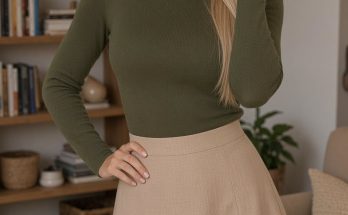
Robert Kane had spent most of his sixty-seven years believing he understood women well enough. Not completely—no man ever did—but enough to feel prepared. He had been married, divorced, and politely dated since, always assuming that confidence announced itself loudly: bold laughter, direct invitations, obvious signals. That assumption followed him into the coastal art gallery on a quiet Thursday evening, where he expected nothing more than abstract paintings and a glass of cheap white wine.
He didn’t expect Helen Alvarez.
She stood alone near a large canvas of muted blues, hands loosely folded, weight settled comfortably on one hip. At sixty-two, she wore her age without decoration or apology. No exaggerated gestures, no restless scanning of the room. She simply occupied her space, calm and grounded, as if she had nothing to prove to anyone there. When Robert paused beside the same painting, she didn’t step away.
That was the first surprise.

Most people created distance without thinking. Helen didn’t. She shifted slightly, just enough that their shoulders were aligned, the closeness quiet but undeniable. She didn’t look at him immediately. She studied the painting a moment longer, then spoke.
“It’s calmer the longer you look at it,” she said.
Her voice wasn’t soft, but it wasn’t sharp either. It carried certainty. Robert nodded, suddenly aware of his own posture, of the way her presence seemed to slow the room around them.
“I think that’s intentional,” he replied.
She turned then, meeting his eyes fully. She didn’t smile right away. She held the moment, measuring him without rush. When she did smile, it was brief, confident, as if she already knew she didn’t need to do more.
They talked—about the ocean nearby, about how taste changes with age, about the relief of no longer needing to impress strangers. As they spoke, Helen stayed close. When people brushed past, she didn’t retreat. When Robert leaned in slightly to hear her over the low music, she stayed exactly where she was. Her arm brushed his, steady, unbothered. No apology. No adjustment.
Robert felt something unfamiliar tighten in his chest. Not nerves. Respect.
He noticed how she listened without interrupting, how her eyes didn’t dart away when he spoke. When he paused, she didn’t rush to fill the silence. She let it exist, let it work. Men weren’t used to that kind of confidence—not the loud kind, but the grounded assurance of a woman who knew her value and didn’t negotiate it.
When the gallery began to empty, Robert assumed the moment would dissolve. Instead, Helen made another choice that caught him off guard. She picked up her coat but didn’t put it on. She stood beside him, close again, and looked toward the door.
“There’s a bench outside,” she said. “The air feels better after sunset.”
It wasn’t framed as an invitation or a test. It was a statement, offered without expectation.
They walked together, steps naturally in sync. On the bench, she sat beside him, leaving just enough space to acknowledge choice. Her knee angled toward his. Her hand rested on the wood between them, close enough that he could feel the warmth of her presence without contact.
Robert realized then how much he had underestimated women like her. Confidence didn’t always chase. Sometimes it waited. Sometimes it chose carefully and stood its ground.
When Helen finally looked at him again, her expression was open, unguarded. “I don’t rush anymore,” she said. “I stay where it feels right.”
Robert understood. And for the first time in years, he didn’t feel like he needed to lead. He just stayed.