The charity gala was exactly the kind of event William avoided—overpriced tickets, underwhelming food, people networking while pretending to care about whatever cause had been selected for the evening. But his firm had bought a table, and his partner had the flu, so here he was in a tuxedo that felt like a costume, nursing champagne and watching the auction with detached amusement.
She was at the table across the room, surrounded by men in various stages of trying too hard. William counted three competing for her attention—a younger man with too much product in his hair, an older man with a watch that probably cost as much as William’s car, and a middle-aged man telling what looked like a very long story.
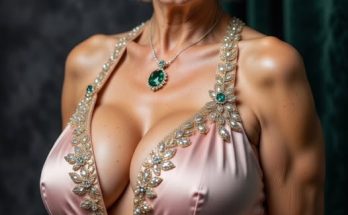
She was listening to all of them and none of them. William could see it in the angle of her body, the way her eyes drifted over their shoulders, scanning the room. She was probably sixty, with silver hair styled in an elegant updo and a black dress that managed to be both appropriate and suggestive—the kind of dress that said I know exactly what I’m doing.
Their eyes met across the crowded room. Held. William felt something like recognition, though they’d never met—an acknowledgment that they were both performing, both watching, both slightly amused by the theater around them.
Then one of her suitors said something that required response, and the connection was broken.
William went back to his champagne. He was too old for this, for the games and pursuit and elaborate courtship rituals. At sixty, he’d earned the right to be direct, to say what he meant, to skip the dances he’d grown tired of decades ago.
He crossed the room anyway.
“Excuse me,” he said to the three men, who turned with various expressions of annoyance and assessment. “I’m stealing this woman for the next dance.”
It was presumptuous. It was arrogant. It was exactly the kind of thing William would have cringed at in his younger self. But something about her—the way she’d looked at him, the recognition in her eyes—made him willing to risk embarrassment.
“I didn’t agree to dance,” she said, but there was laughter in her voice, not offense.
“You didn’t say no either.” He extended his hand. “William. And I’m assuming you want to escape this conversation as much as I want to interrupt it.”
She looked at his hand. Looked at the three men, who were shifting uncomfortably, unsure whether to defend their territory or retreat gracefully. Then she took William’s hand and let him lead her to the dance floor.
“That was either very brave or very rude,” she said, as they settled into position for a slow song.
“Probably both.” William’s hand found her waist, and she fit against him with the ease of someone who’d danced many times before. “But you were sending distress signals. I chose to interpret them as a cry for help.”
“I wasn’t sending any signals.” But she was smiling, and her body was relaxed in his arms, not stiff or resistant.
“Your eyes were searching the room like you were looking for an exit. Your shoulders were angled away from your admirers. And when our eyes met, you held the contact longer than politeness requires.” William spun her gently, enjoying the way she moved with him, anticipating his lead. “Those are signals.”
“Maybe I was just bored.”
“Maybe.” He pulled her closer, close enough to smell her perfume—something expensive and subtle, jasmine and sandalwood. “Or maybe you were looking for someone worth talking to.”
They danced in silence for a moment, the music swelling around them, other couples swaying in various states of coordination and enthusiasm. William was acutely aware of her in his arms—the warmth of her back beneath his hand, the way her breath hitched slightly when he pulled her closer, the scent of her hair when she turned her head.
“I’m Catherine,” she said finally. “And you’re either remarkably perceptive or dangerously presumptuous.”
“Can’t I be both?”
“You can be whatever you want.” She pulled back enough to meet his eyes, and what he saw there made his heart rate increase—interest, challenge, something warm and welcoming beneath the polished surface. “But I should warn you, William. I’m not looking for anything complicated.”
“What are you looking for?”
Catherine’s gaze held his. “Honesty. Directness. Someone who says what they mean instead of what they think I want to hear.”
“I want to kiss you,” William said. “Right now, in the middle of this dance floor, surrounded by people who paid too much money to watch us. I want to know if your mouth tastes like champagne. I want to know if you pull away or pull closer.”
Catherine didn’t pull away. But she didn’t move closer either. She just looked at him with those eyes—gray-green, intelligent, ancient in a way that suggested she’d seen too much to be easily surprised.
“I said I’m not looking for anything complicated,” she repeated.
“And I said I want to kiss you. Those don’t contradict each other.”
She laughed, low and throaty. “You don’t give up easily, do you?”
“Not when I see something worth pursuing.”
The song ended. They stood there for a moment, still in each other’s arms while other couples drifted off the floor. Catherine’s hand was on his shoulder, her body still close enough that he could feel her heartbeat.
“No,” she said.
William felt the word like a physical blow. He started to step back, to apologize, to retreat with whatever dignity he could salvage.
But Catherine’s hand tightened on his shoulder. Her eyes held his, and what he saw there wasn’t rejection. It was something else entirely—challenge, invitation, a dare wrapped in denial.
She said no. Her eyes said yes.
William understood. This was a test, a game, a negotiation conducted in glances and touches rather than words. She wanted to see if he was paying attention. If he could read between the lines. If he was smart enough to understand that sometimes ‘no’ meant ‘prove you want this enough to try again.’
He leaned in anyway. Close enough that their breath mingled, close enough to see the flecks of gold in her gray-green eyes, close enough to feel the heat radiating from her skin.
“Your mouth is saying no,” he whispered. “But your eyes are saying something else entirely. Which should I believe?”
Catherine’s lips parted. Her pupils dilated. And then she closed the distance herself, kissing him in the middle of the dance floor while the orchestra started a new song and the room spun around them.
“Believe the eyes,” she said, when they finally broke apart. “Always believe the eyes.”
William smiled and pulled her closer, already looking forward to learning whatever other secrets Catherine’s eyes might reveal.