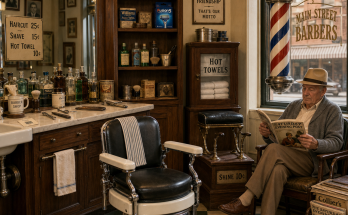
Rafe Marquez, 57, spends six days a week hunched over a light table in his 300-square-foot Portland shop, patching tears in 100-year-old nautical charts and touching up faded ink on forest service maps. His hands are crisscrossed with tiny cuts from X-Acto knives, his flannel shirts permanently stiff with glue residue, and he hasn’t let anyone outside of a regular customer spend more than 10 minutes in his space since his wife left him for a SaaS sales rep eight years prior. His only consistent social outing is the Saturday farmers market, where he sells framed vintage map prints, and he’s perfected the art of polite small talk that cuts off before anyone can ask personal questions.
The October air is sharp with apple cider and wood smoke the first Saturday he notices the new hot honey booth set up three feet to his left. He’s arranging a 1972 print of the Columbia River Gorge when a woman leans over the flimsy metal divider between their stalls, her elbow brushing his bicep as she points at the map. “You still have that old thing?” she says, and he freezes. He recognizes the faint scar snaking across her left wrist first, from the time she fell off his fishing boat when she was 16, then the gap between her front teeth, the same sun-bleached blonde hair she had back then. It’s Lila, his ex-wife’s younger cousin, the kid who used to crash on his couch every summer to escape her parents’ house in Phoenix. He hasn’t seen her in 12 years, not since the last family Christmas before his divorce.

He stammers a greeting, his chest tight with a weird mix of guilt and curiosity. He’d heard through the grapevine she’d moved out of state, never expected her to pop up here, selling jars of honey dusted with chili flakes and cinnamon. She’s 42 now, laugh lines fanning out from her eyes, a silver hoop through her left nostril, and he catches himself staring at the way her shirt pulls tight across her shoulders when she reaches for a sample jar. He feels stupid for it, wrong, even—she’s still technically family, sort of, his ex’s side of the family has painted him as a deadbeat for years, said he cared more about old paper than his marriage. Part of him wants to pack up his booth early, run back to his shop and hide behind his stacks of maps, but the other part of him can’t look away.
She brings him a sample of her mango-infused hot honey an hour later, and their fingers brush when he takes the jar from her. The jolt is so sharp he drops the lid, and they both bend down to grab it at the same time, their foreheads bumping softly. He smells lavender perfume and wildflower honey on her hair when he’s that close, and his face heats up like he’s a teenager fumbling through his first makeout. She laughs, not at him, warm and easy, and says she always hated how her cousin treated him, thought he was the only grownup in that whole family who ever listened to her when she was a kid. She stays and talks to him between customer stops, asks him about the stories behind the maps, remembers the names of all the old explorers he used to tell her about on summer road trips.
The rain hits without warning at 3 PM, hard, fat drops that soak through the canvas of his pop-up tent in 30 seconds flat. The market clears out fast, vendors scrambling to cover their stock before it gets ruined. A gust of wind blows a stack of his unframed gorge prints off the table, and Lila runs over to help him grab them before they blow into the mud. She slips on a patch of wet asphalt, and he catches her around the waist, pulling her tight against his chest to keep her from falling. They’re both soaked to the bone, standing under the last dry edge of his tent, rain pouring down around them so loud he can barely hear the distant honk of traffic. Her face is inches from his, her breath coming fast, her hands fisted in the front of his flannel. “I always thought you were too good for her, you know that?” she says, quiet enough only he can hear it.
He doesn’t overthink it, doesn’t spiral into guilt about what his ex would say, doesn’t tell himself he’s too old or too broken for this. He just leans in, kisses her slow, tastes honey and cinnamon on her lower lip, and for the first time in eight years, he doesn’t feel like he’s just treading water until he dies. She kisses him back, one hand coming up to cup the back of his neck, her fingers cold from the rain but her palm warm against his skin.
They pack up their booths together, moving fast to keep their stock from getting ruined, and he offers to drive her back to her apartment when she mentions her truck got a flat tire that morning and she’d been planning to Uber home. They stop at a taco truck on the way, order carnitas and pickled red onions, eat in the cab of his beat-up 2008 Ford F150 while rain taps against the windows. She asks if he wants to come up to her place to try her new batch of bourbon-infused honey, says she’s been tweaking the recipe for weeks and wants an honest opinion. He says yes, no hesitation. He tucks a wet strand of hair behind her ear before opening the truck door for her, the crinkle of the leftover taco wrapper in his pocket a quiet reminder that not every old rule is worth keeping.