Sixty-two-year-old Milo Thorne, retired National Park Service backcountry ranger, spent 34 years patrolling Mount Hood National Forest before a torn rotator cuff forced him to hang up his boots four years prior, the same year his wife Claire died of ovarian cancer. He’s a creature of unshakable habit, eats the same egg and sausage breakfast every morning, still keeps Claire’s scuffed sheepskin slippers by the front door even though the lining’s falling out, and hits the Hood River farmers market every Saturday at 9 a.m. sharp for O’Henry peaches and pickled garlic. Mid-August humidity hangs thick enough to drink, the air sharp with the smell of fried onion rings from the food truck by the entrance and cut clover from the empty lot next door, and he’s been actively avoiding the far end of the market for three weeks, ever since he heard Claire’s younger cousin Lila moved back to town to sell raw wild honey from hives she inherited from her dad.
His usual peach vendor is gone for the week, grandson playing in a regional Little League tournament, and he drifts toward the far end without meaning to, the thick, sweet scent of honey cutting through the onion ring grease before he spots her wooden stand stacked with glowing golden jars. She calls his name first, loud enough that two old ranger buddies he’s known for 20 years glance over and snicker, and he freezes before forcing a casual smile and walking over. She’s leaning against the stand in cutoff denim overalls over a faded white tank top, sun streaks in her dark brown hair, freckles across her nose he doesn’t remember from Claire’s funeral four years prior. She’s 48, just finalized her divorce from a Bend ski shop owner who cheated on her with a 22-year-old lift attendant, she tells him when he asks how she’s been, and she laughs when he admits he’s been avoiding her stand because he didn’t know what to say.

She hands him a honey dipper loaded with wildflower honey, their fingers brushing when he takes it, and he feels a jolt run up his arm that he shoves down immediately, guilt coiling tight in his chest. He’d felt the same stupid jolt at Claire’s funeral, when Lila hugged him tight and smelled like pine and honey, and Claire used to tease him back when they were in their 20s that Lila had a massive crush on him, that she’d drive three hours from Portland just to hang out when he was home from patrols. He licks the honey off the dipper, sweeter than any he’s ever had, and tells her so. She asks if he can help her carry a heavy crate of extra jars to her truck in 10 minutes when the market closes, says her shoulder’s been messed up since she lifted 12 hive boxes the day before, and he agrees before he can talk himself out of it, even though he can see the church ladies from Claire’s old congregation staring and whispering into their canvas tote bags.
They carry the crate together, his arm pressed tight to hers the whole walk to the parking lot, the rough wood digging into his palm, the heat from her skin seeping through the thin flannel he wears even in 80-degree heat. She asks if he’s still any good at fixing leaky faucets, says the old cabin she’s renting on the edge of the national forest has a kitchen tap that’s been dripping for a week, she’s tried three different YouTube tutorials and can’t get it to stop. He says he’s got a full toolbox in the back of his beat-up Ford F-150, can swing by after he drops his groceries off. He stands in his kitchen for 10 minutes after unloading his tomatoes and garlic, staring at Claire’s photo on the fridge, telling himself he’s being an idiot, that this is wrong, that the whole town will talk. But he remembers the way Lila smiled at him, the way her hand felt when it brushed his, and he grabs his toolbox and drives back out.
Her cabin is small and cozy, smells like cinnamon and beeswax, bee-printed tea towels hanging over the sink. He fixes the faucet in 12 minutes flat, used to patching far worse plumbing in backcountry ranger stations in the middle of winter. She hands him a cold IPA when he’s done, their fingers brushing again when he takes it, and neither of them pulls away this time. She tells him Claire called her two weeks before she died, told her if she ever moved back to Hood River she needed to make sure Milo wasn’t surviving on frozen burritos and canned soup, told her he was too stubborn to ask for help when he needed it. The tight knot of guilt in his chest loosens, just a fraction. She says she’s liked him since she was 19, came to visit Claire at their old Portland apartment and saw him haul a 60-pound backpack up three flights of stairs after a two-week patrol, thought he was the toughest, sweetest guy she’d ever met.
He doesn’t say anything for a minute, just stares at her, the golden late afternoon light hitting her hair so it glows, a fleck of bee pollen stuck to her cheek. He reaches out, brushes the pollen off with his thumb, his skin brushing hers soft and warm, and she leans into the touch just a little. He tells her he’s been scared to feel anything but sad for four years, scared people would think he was forgetting Claire, scared he was betraying her. She snorts and says Claire would kick his ass if she saw him moping around his cabin alone eating frozen burritos for dinner every night, and he laughs, a real, unforced laugh, the first one he’s had in months. They order pepperoni pizza from the old downtown spot he and Claire used to go to for date night, eat it at her kitchen table, talk until the sun goes down and crickets chirp loud outside the window. He doesn’t drive home that night.
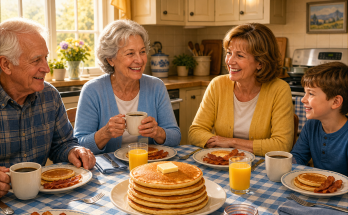
He wakes up at 7 a.m. the next morning, the smell of dark roast coffee drifting from the kitchen, the sound of Lila singing a 90s Trisha Yearwood song under her breath. He swings his legs over the edge of the bed, spots a jar of her wildflower honey on the nightstand next to a glass of water, and walks into the kitchen. She’s standing at the stove flipping pancakes, wearing one of his old flannel shirts he thought he lost at the funeral, and turns to smile at him, setting a chipped ceramic mug of black coffee down on the table in front of him, just how he likes it. He lifts the chipped ceramic mug she set down for him, and takes the first sip that doesn’t taste like grief.