Moe Sorrentino, 62, retired high-voltage lineman from east Tennessee, had spent eight years perfecting the art of skipping neighborhood events. His wife, Jean, had been the one who dragged him to potlucks and cookouts before breast cancer took her, and after she was gone, he’d told everyone he preferred puttering in his garage restoring vintage Ford pickups to making small talk with people who only wanted to ask if he was “seeing anyone yet.” His only flaw, if you asked his 16-year-old granddaughter Lila, was that he was stubborn enough to cut off his own nose to spite his face when it came to letting new people in. He’d only caved to coming to the church summer cookout because Lila had begged, said she’d spent three hours making a batch of peach lemonade from the tree in his backyard and needed his honest feedback.
The air reeked of charcoal and grilled bratwurst, kids screaming so loud on the bounce house set up on the lawn that his left ear, half-deaf from years of standing next to line transformers, rang a little. He was reaching for a chili dog off the grill when someone’s hip slammed into his bad right knee, the one he’d messed up in a 2017 storm surge repair when a falling branch took him off a 12-foot ladder. He grunted, catching himself on the edge of the folding table, and a woman’s hand wrapped around his left forearm for half a second, right over the thick, silvery scar he’d gotten from that same storm, when a frayed line had burned through his work glove.

“Sorry, I was chasing a kid who stole three packs of gummy bears and didn’t see you,” she said, and he looked up. She was 54, maybe, dark hair streaked with gray pulled back in a loose braid, a smudge of charcoal on her left cheek, wearing a linen button down and steel-toe work boots, not the fancy sandals and frilly church dresses he was used to seeing on the women who hung around these events. She was Clara Bennett, the new elementary school principal who’d moved to town three months prior, and he’d already written her off as the type who’d be calling him in six months to complain about his scattered truck parts taking up half the curb in front of his house.
He mumbled that he was fine, pulled his arm back like he’d been burned, and went to find Lila’s lemonade stand. The lemonade was sweet, just the right amount of tart, sticky on his fingers when he set the paper cup down, and he was about to sneak back to his truck when Clara walked up next to him, holding her own cup. “That’s your 1972 F100 parked by the oak tree, right?” she said, nodding toward the curb. “My dad had the exact same one, two-tone red and white, I helped him rebuild the carburetor when I was 14. I just bought a beat-up 1968 F150 off old Marty down on Maple Street last week, can’t figure out why the fuel pump keeps dying on me.”
Moe blinked. He’d spent the last three months assuming she was a stuffy bureaucrat who couldn’t tell a wrench from a screwdriver, and now she was asking about carburetor jet sizes. They ended up leaning against the side of his truck for an hour, talking, their arms brushing every time one of them shifted, the rough cotton of her shirt scraping lightly against his bare forearm, the sound of her laugh low and rough, nothing like the high, fake little titters he’d gotten from every woman at the church who’d tried to set him up with their sister or cousin over the years. He kept waiting for the other shoe to drop, for her to start asking about his love life or tell him he needed to clear his truck parts off the curb, but she never did. She asked about the scar on his arm, listened when he told her about the 2017 storm, didn’t flinch when he described the way the line had burned through his glove so fast he hadn’t even felt it at first.
Most of the crowd had left by 8, the sun dipping low enough that the sky was pink and tangerine over the Smoky Hills, Lila had left with her friend to go get soft serve, and they were sitting on the tailgate of his truck now, their knees brushing every time one of them moved. She leaned in a little when she was talking about the time her dad had dropped a transmission on his foot, her shoulder pressing against his, and he could smell lavender perfume mixed with leftover charcoal smoke and the faint sweet scent of peach lemonade on her breath. He’d spent eight years telling himself he didn’t need anyone new in his life, that getting close to someone just meant having to grieve them all over again, that the risk wasn’t worth the reward, and for a second he almost made an excuse to leave, to go back to his garage where it was safe and predictable.
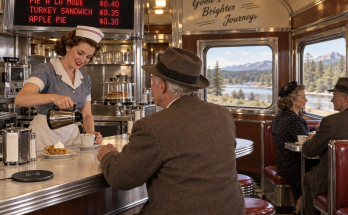
Then she turned to him, squinting a little in the sunset, and asked if he’d be willing to come look at her F150 this weekend, maybe teach her how to replace the fuel pump herself, said she’d pay him in peach pie from the diner on Main Street, the one with the crumb topping he’d been eating since he was a kid. He hesitated for two beats, then nodded. She grinned, handed him a crumpled scrap of receipt paper with her phone number scrawled on it in blue ballpoint, and hopped off the tailgate, waving as she walked to her beat-up sedan parked down the street. He sat there for another ten minutes, twisting the scrap of paper between his fingers, the stickiness of lemonade still on his thumb, watching the last of the sun dip below the hills. He reached into his pocket, pulled out his beat-up old flip phone, and typed her number into the contacts list.