Roland Voss, 51, spent 22 years as a wildland fire crew boss before a 2021 blaze in the Cascades left him with a fused left ankle and a permanent distaste for crowded spaces. He’d moved to the tiny Oregon coastal town of Bayport two years prior, fixed vintage fishing reels for extra cash, and only left his cabin two nights a week: Tuesdays for The Salty Spur’s $1 oyster special, Fridays for the community trout weigh-in. His most consistent personality flaw? He’d shut down every attempt at casual conversation with locals for 8 years, ever since his wife died in a car crash on her way to visit him at a fire base. He’d convinced himself he didn’t need anyone, that the quiet was better than the risk of losing something all over again.
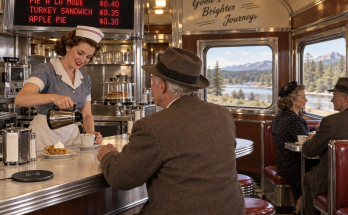
That Tuesday, he was perched on the far end of the bar, scuffed work boots propped on the lower rail, a half-drunk pint of hazy IPA sweating next to a mason jar of disassembled Penn reels, when she slid onto the stool two seats down. The bar was half-empty, jukebox spitting out Johnny Cash’s *Folsom Prison Blues* at a volume just low enough to hear the waves crashing a block away. She ordered a glass of pinot noir, fumbled her wallet when she went to pay, and it slid across the linoleum right to his feet. He leaned down to grab it, and when he handed it over, their fingers brushed. Her skin was cool, softer than anything he’d touched in years, and she smelled like sea salt and jasmine hand lotion. She held his gaze for three full beats, longer than polite, her dark eyes flicking to the scar slashing across his left cheek before she smiled, small and sharp. “Thanks. I swear I’m usually less clumsy.”

He grunted in response, already turning back to his reels, ready to shut the conversation down. But then she spotted the mason jar, leaned in a little closer, her shoulder almost brushing his bicep through his worn fire crew flannel. “Is that a 1998 Penn Spinfisher? My dad had one exactly like that, used it for king salmon out of Homer back in the 2000s. He swore nothing else could hold a 40-pound fish.”
He froze. No one had asked him about his reels in months, let alone known the exact model off the top of their head. He found himself turning back, telling her about how he’d found that specific reel at a garage sale down the coast, how he was fixing it up for the teen who bagged his groceries at the general store. She laughed when he complained about how hard it was to find replacement parts for older models, and the bartender slid a plate of a dozen oysters between them without asking, winking. Their elbows knocked when they both reached for the first one, and he felt the heat of her arm linger even after she pulled back to douse her oyster in hot sauce.
The longer they talked, the tighter the knot in his chest got. Half of him was screaming to leave, to go back to his empty cabin, to stop disrespecting his wife’s memory by flirting with a stranger. The other half couldn’t remember the last time someone had talked to him like he wasn’t a broken ghost, like the scar on his face and the limp in his step were just parts of him, not warning signs to stay away. She told him she was Elara, the new town librarian, had moved there three months prior from Portland, was sick of the guys at the marina hitting on her every time she asked about renting a boat to see the bioluminescence that rolled through the bay that time of year. “They all act like I owe them something just for giving me a ride,” she said, rolling her eyes, and he nodded, he knew the type.
Then she did it. She reached out, brushed a strand of wind-tousled gray hair off his forehead, and her thumb grazed the raised edge of his scar, light as a feather. “You know, that scar’s not as intimidating as you think it is,” she said, quiet enough no one else could hear. “Looks like you’ve got stories worth telling.”
The knot in his chest unraveled all at once. He told her he had a 17-foot Boston Whaler docked at the public marina, he’d take her out to see the bioluminescence whenever she wanted, no strings attached, as long as she brought that pinot noir she liked. She grinned, pulled a pen out of her jacket pocket, scribbled her number on a napkin, and slid it across the bar to him.
They finished their drinks an hour later, and he walked her to her beat-up blue Subaru parked out front, the rain starting to mist down, salt tang in the air. She leaned in before she got in the car, kissed his cheek right next to the scar, her lips warm against his cold skin, and said she’d text him Thursday to pick a day. He stood in the parking lot long after her taillights vanished around the corner, the napkin crumpled in his pocket, the faint smell of jasmine still clinging to his flannel sleeve. He reached up, touched the spot where she’d kissed him, and realized he was smiling, a real, unforced smile, for the first time in eight years.