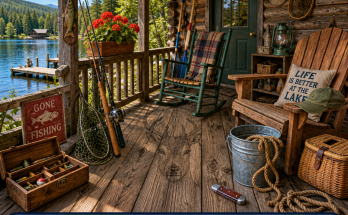
Rico Marquez, 52, makes his living building custom fishing rods out of the cinder block garage attached to his Port Aransas bungalow. His hands are crisscrossed with tiny scars from utility knives and sanding belts, sun spots dotting his forearms from decades on the water. He’s at the annual fire department chili cookoff only because his high school buddy, the fire chief, begged him to judge, paying him back for the free custom rod he built for the department’s patrol boat the month prior. He’s leaning against the tailgate of his beat-up 2007 F150, sipping sweet tea from a dented styrofoam cup, watching a group of retired shrimpers yell over whose brisket has the right amount of oak smoke. He hasn’t stayed at a public event longer than 45 minutes in six years, ever since his wife died of breast cancer, and he already has a frozen lasagna waiting in his fridge for when he bails early.
He spots her across the pavilion first, kneeling on the dirt to help a harried seven-year-old pick up a spilled jar of pickled okra, laughing so hard her shoulders shake instead of scolding him for running too fast. She’s got dark hair pulled back in a messy braid, a single thick silver streak running above her left ear, cut-off jean shorts and a faded Texas A&M marine biology hoodie tied around her waist. He doesn’t recognize her, figures she’s the new county librarian everyone at the bait shop has been chattering about, the one who moved into the old blue bungalow three blocks from his shop last month. He can’t look away, even when one of the other judges slaps his shoulder to hand him a sample of overcooked beef chili.

She makes her way over to his judge’s table 20 minutes later, a chipped ceramic crockpot slung over one arm, a plate of crumbly cornbread balanced on top. Her name is Lila, she says, sticking her hand out to shake. Her grip is firm, her palm calloused too, she says she’s been patching the 100-year-old oak shelves in the library basement by herself after work. Her entry is mango habanero chili, recipe from her grandma who grew up outside McAllen, she says, pushing a sample bowl across the table to him. He takes a bite, sweet first, then slow, warm heat that lingers at the back of his throat, better than anything he’s eaten in months. He tells her it’s easily the best entry he’s tasted all day, and she leans in, her shoulder brushing his bicep as she points out the flecks of smoked paprika she toasted on her camp stove the night before on a weekend trip to the national seashore. He smells coconut shampoo and cedar smoke, and his chest tightens, half panic, half a feeling he hasn’t let himself acknowledge in eight years.
They talk for 40 minutes straight, the noise of the George Strait cover band and screaming kids fading into the background. He tells her about the custom handles he carves from cedar fallen during hurricane season, the tiny hand-painted fish he etches into the base of rods for kids getting their first ever setup. She tells him she’s been trying to learn to redfish on her own, but her cheap big-box store rod keeps snapping every time she hooks something bigger than a perch, and she checked out his 12-year-old self-published rod building guide from the library, dog-eared half the pages but couldn’t wrap her head around the technical wrapping terms. He almost offers to help, then catches himself, that familiar cold voice in his head telling him to keep his distance, that letting someone in only means more pain down the line. He mumbles an excuse about needing to head out, pushing his chair back to stand.
She reaches out before he can move, brushing a crumb of cornbread off the front of his grease-stained flannel. Her fingers linger on his chest for half a second, warm even through the thick fabric, and she holds his gaze, no awkwardness, no overthinking, just a small, lazy smile. She says she needs a custom rod built for her nephew’s 12th birthday, and she’ll pay him in homemade key lime pie and a case of the hazy IPA he has stacked in the back of his truck, she spotted it when he opened the tailgate earlier. He stares at her for three full seconds, warring between the part of him that wants to run home to his quiet garage and frozen lasagna, and the part of him that hasn’t laughed that easy with someone in almost a decade. He says yes. Before he can talk himself out of it, he adds that they can test the rod on his flats boat at sunrise the next Saturday, no crowds, just the marsh and the fish, if she wants. She grins, says she’ll bring extra pie and a second cooler of beer, as long as he brings the homemade smoked sausage he mentioned he cures himself every fall.
Sunrise the next Saturday is soft pink and tangerine, painting the marsh grass gold when he pulls his boat up to the public dock. She’s already there, holding a foil-covered pie tin in one hand, a beat-up tackle box slung over her shoulder, wearing waders that are two sizes too big, cuffed at the ankles. They drift for three hours, him showing her how to cast low over the grass, how to feel for a nibble through the rod, how to reel slow when a redfish takes the bait. She hooks a 22-inch red an hour before they’re supposed to head back, whooping so loud a flock of herons take off from the reeds nearby, stumbling a little when the fish pulls hard against the line. He reaches out, his hand wrapping around her waist to steady her, and she leans back into his side, no hesitation, no pulling away, just laughing as she cranks the reel. He rests his other hand on top of hers on the rod grip, helping her pull the fish up over the side of the boat.