Douglas Reed had always liked being the one who set the pace.
At sixty-seven, a retired radio host with a voice that had carried through late-night airwaves for three decades, he understood rhythm. Timing. Cadence. He knew when to pause for effect, when to lean into a sentence, when to let silence do the work.
Off-air, he approached women the same way—light humor, controlled charm, a steady build.
It had always worked.
Until he met Evelyn Harper.
She was sixty-five, recently retired from running her own accounting firm. Practical, sharp-minded, with a posture that suggested she’d never waited for permission to speak. Her dark hair, streaked with silver, was worn straight and sleek, brushing her shoulders. She dressed simply—well-fitted jeans, soft blouses, low heels—but carried herself like someone entirely comfortable in her own skin.
They met at a wine and poetry night hosted at a small independent bookstore downtown. Douglas had been invited to read a few short pieces on stage. Evelyn was there with a friend, seated near the back.
When he finished reading, she approached him without hesitation.
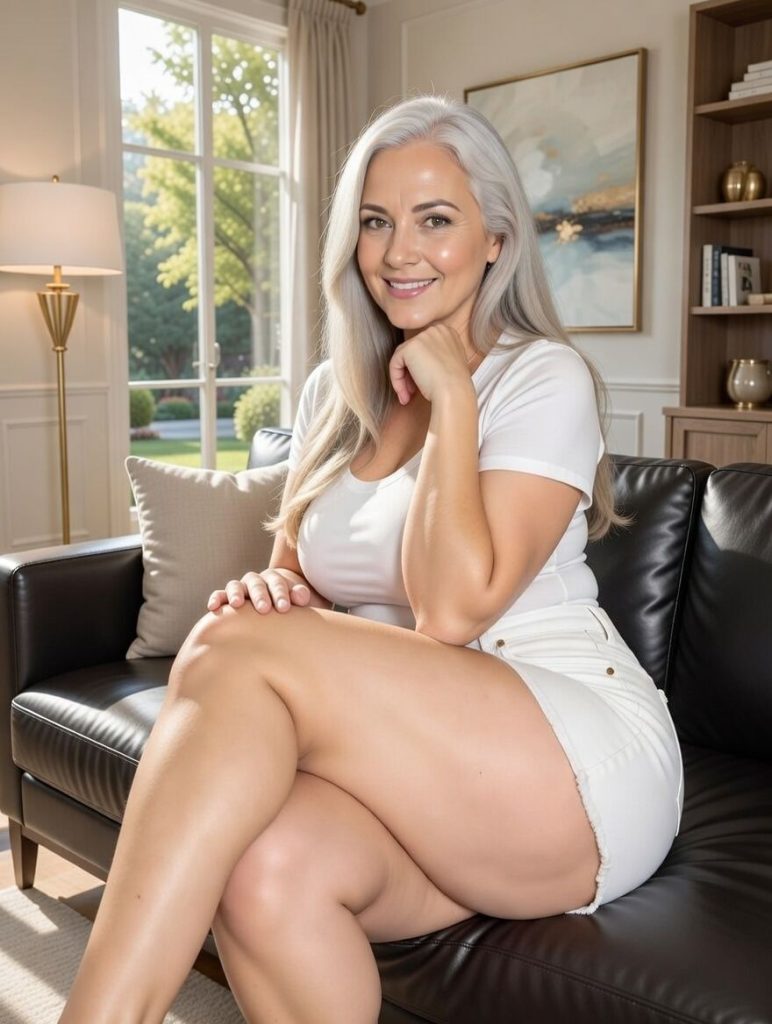
“You know how to use a pause,” she said, meeting his eyes directly.
Douglas smiled. “Comes from years behind a microphone.”
She studied him a moment longer than most would dare. “Most men rush the silence.”
The way she said it wasn’t flirtatious.
It was observational.
That was the first shift.
Over the next few weeks, they began meeting for coffee. Douglas noticed quickly that Evelyn didn’t wait for him to guide conversation. She steered naturally—asking pointed questions, redirecting topics, holding eye contact without blinking first.
One afternoon, seated at a small café table by the window, Douglas leaned forward, lowering his voice slightly as he shared a personal story. It was a move he’d used countless times—a subtle invitation into intimacy.
Evelyn listened.
Then she leaned back.
Not disengaging.
Assessing.
“You’re very practiced,” she said calmly.
He chuckled. “Occupational hazard.”
Her gaze softened, but there was something else beneath it.
“At sixty-five,” she replied, “I don’t respond to practiced.”
The words didn’t sting.
They recalibrated.
Later that evening, they walked along the riverfront promenade. The sky was streaked with orange and purple, the air cool against their skin.
Douglas reached for her hand instinctively, timing it between steps.
She let him take it.
But instead of following his pace, she slowed slightly.
He noticed immediately. His stride shortened to match hers.
She glanced up at him, subtle satisfaction in her eyes.
“That’s better,” she murmured.
The rhythm had shifted.
It wasn’t about resistance.
It was about control—hers.
They stopped near the railing overlooking the water. Evelyn turned to face him fully. She stepped closer—not tentative, not coy.
Deliberate.
Douglas felt the space compress between them.
Her hand slid from his into the front of his jacket, fingers resting lightly against his chest.
His breath hitched almost imperceptibly.
“You’re used to leading,” she said softly.
“And you’re not?” he replied.
Her lips curved slightly.
“I’ve led my entire life.”
Her thumb traced a slow arc over his sternum, feeling the steady beat beneath.
“At this age, I don’t wait to see if a man chooses me. I decide if I choose him.”
The clarity of it changed something inside him.
He had always believed attraction was a dance he conducted.
Now he realized she wasn’t following.
She was setting the tempo.
Evelyn stepped even closer, her body aligning with his. Her confidence wasn’t loud. It wasn’t aggressive.
It was grounded.
She held his gaze, letting the silence stretch—not awkwardly, but intentionally.
Douglas felt the familiar urge to fill it with a witty remark.
He didn’t.
He waited.
Her fingers slid from his chest to the back of his neck, firm and warm. She didn’t yank him closer. She guided him.
Slowly.
The kiss wasn’t rushed. It unfolded in layers—steady, assured, controlled by neither but initiated by her certainty.
When they parted, she didn’t step away.
She rested her forehead lightly against his.
“Feel that?” she asked quietly.
He nodded.
“At sixty-five,” she continued, “I don’t chase rhythm. I create it.”
Douglas let out a low breath, half a laugh.
“For someone who talks for a living,” he said, “I’m suddenly out of lines.”
She smiled, brushing her lips lightly against his once more.
“Good.”
He understood then.
Her confidence didn’t overpower him.
It rebalanced him.
The old cadence—his practiced charm, his controlled pacing—had softened into something mutual.
And as they stood there beneath the fading light, her hand steady at his collar, Douglas realized something he hadn’t felt in years.
He wasn’t leading.
He wasn’t performing.
He was responding.
And at sixty-seven, that new rhythm felt better than any applause he’d ever heard.