Harold Bennett had always believed there would be more time.
At sixty-three, a widowed financial advisor in Marin County, he lived a life that looked solid from the outside—orderly routines, a respected career, a quiet house overlooking the bay. Everything in its place. Everything accounted for.
Except the one thing he never quite figured out how to hold onto.
Connection.
It wasn’t that Harold lacked opportunity. Over the years, there had been women—intelligent, warm, interested in him in ways he only half understood. But something always slipped. Conversations that felt promising would stall. Moments that could have deepened into something real… simply faded.
He used to think it was bad timing.
Or bad luck.
He didn’t realize the pattern was him.
That truth didn’t begin to show itself until a late September evening, at a neighborhood wine tasting hosted by a mutual friend. Harold almost didn’t go. But something about the silence in his house that afternoon felt heavier than usual, and he needed a break from it.
That’s where he met Sandra Whitaker.
She stood near the back patio doors, a glass of pinot noir in hand, listening more than speaking. Mid-fifties, understated elegance, with a quiet confidence that didn’t need decoration. There was a softness to her expression—but not fragility. Experience, maybe. The kind that didn’t announce itself but lingered in the way she held eye contact just a second longer than expected.
Harold noticed her early.
And, like always, he hesitated.
It took him twenty minutes before he finally walked over.
“Good turnout,” he said, immediately aware of how ordinary it sounded.
Sandra turned, her eyes meeting his without hesitation. “It is,” she replied, a hint of a smile forming. “Though most people are more interested in talking than tasting.”
Harold chuckled lightly. “That’s usually how it goes.”
They fell into conversation. Easy at first—wine, the host, the usual safe ground. Then gradually, it shifted. Work, past travels, small fragments of their lives unfolding in careful layers.
Harold felt something he hadn’t felt in a while.
Interest.
Real, steady interest.
And then, without realizing it, he did what he had always done.
He leaned forward—not physically, but in energy. His questions came faster. His stories stretched longer. He began shaping his words, choosing details that made him sound just a little more impressive, a little more… worth it.
Sandra didn’t pull away.
But she didn’t move closer either.
That was the part Harold used to miss.
The absence of movement.
The quiet plateau where things stopped growing—but hadn’t yet fallen apart.
She took a sip of her wine, her gaze drifting briefly across the room before returning to him. Still polite. Still engaged.
Just… not deeper.
Something in Harold tightened.
A familiar feeling. One he had never been able to name before.
Until now.
He stopped mid-sentence.
Actually stopped.
It surprised even him.
Sandra tilted her head slightly. “You were saying?”
Harold let out a small breath, almost a laugh. “I was… probably talking too much.”
That earned him a different kind of look.
Curiosity.
Not surface-level. Something more focused.
“Most people do,” she said gently.
Harold nodded, this time not rushing to fill the space. His hands settled around his glass, his posture easing back, like he had finally stepped out of something he didn’t realize he’d been inside.
For the first time that night, he wasn’t trying to guide where things would go.
He just… let it be.
The silence that followed wasn’t awkward.
It was open.
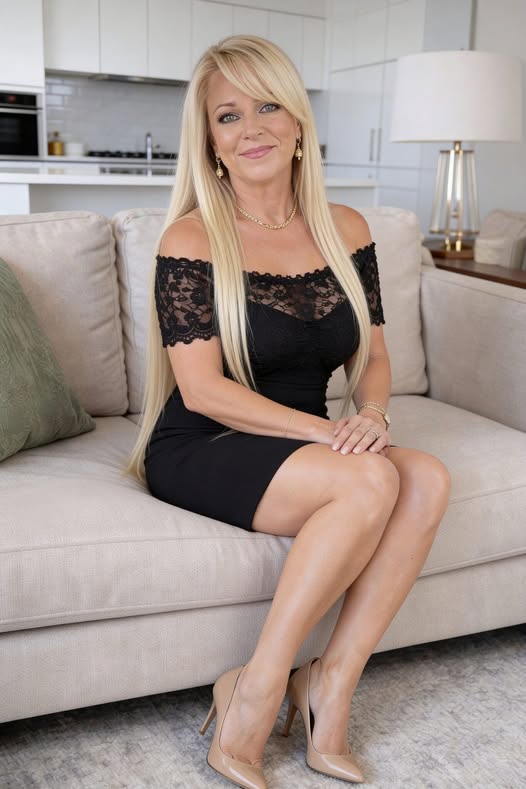
Sandra shifted slightly closer, her shoulder angling toward him now, her body no longer divided between him and the rest of the room.
A small change.
But unmistakable.
“You know,” she said quietly, “it’s rare for someone to catch that in the moment.”
Harold met her eyes. “Catch what?”
“That they’ve started trying.”
There it was.
Simple.
Direct.
And somehow heavier than anything else she could have said.
Harold exhaled slowly. “I think I’ve been doing that for a long time.”
Sandra studied him for a second, then smiled—not politely this time, but with a warmth that felt earned.
“Most men do,” she said. “They just don’t realize what it costs them.”
Harold didn’t ask her to explain.
Because something in him already understood.
All those moments. All those almost-connections. The subtle distance he could never close.
It wasn’t about saying the wrong thing.
It was about not knowing when to stop saying anything at all.
Sandra’s hand rested lightly on the edge of the table between them. Not reaching. Not pulling away. Just there, steady, unforced.
Harold noticed.
This time, he didn’t rush toward it.
He let the moment breathe.
And after a second, her fingers moved—just enough to brush against his. Soft. Intentional.
A quiet signal.
One he might have missed years ago.
“You feel different now,” she said, her voice low.
Harold gave a faint smile. “I stopped trying to get somewhere.”
Sandra held his gaze. “Exactly.”
The noise of the gathering faded into the background again, replaced by something quieter, more grounded. Real.
They didn’t rush after that.
Didn’t push.
When they eventually stepped out onto the patio, the evening air cool against their skin, it felt natural—not like progress, not like effort. Just two people standing a little closer than before, sharing something neither of them needed to name.
Later, as Harold walked back to his car alone, something stayed with him.
Not regret.
Not this time.
Clarity.
Because the truth he had spent years missing wasn’t complicated.
It just arrived too late for most men to use it.
Attraction doesn’t fade because you’re not enough.
It fades the moment you start trying to prove that you are.
And by the time most men understand that…
The moment they could have let it happen has already passed.