Rafe Mendez, 62, retired long-haul trucker, leans against the side of his dented 1994 F-250 at the New Braunfels annual fall chili cookoff, mesquite smoke curling thick through the crisp October air. His knuckles are crisscrossed with scabs from prying a rusted exhaust manifold off a 1972 F-100 earlier that week, a frayed leather bracelet—Elaina’s, the one she bought him at a Wyoming roadside stand in 1991—circled tight around his left wrist. He’s been manning his booth since 7 a.m., his brisket chili already gone through three half-gallon batches, the sign taped to the front scrawled in Elaina’s loopy old handwriting, the same one they used for 22 straight cookoffs before she got sick. Crushed pecan shells crunch under his work boots, the faint sweet tang of kettle corn from the booth down the row mixing with the sharp, spicy smell of chili simmering in cast iron pots.
Clara Hale, 48, the county’s new agricultural extension agent, walks up, a paper plate stacked with crumbly cornbread in one hand, a half-empty sample cup in the other. Her auburn hair is pulled back in a loose braid, a thick streak of silver cutting through the hair above her left ear, work boots caked in red clay from checking a rancher’s pasture earlier that day. She’d stopped by his garage twice the week before, asking about the 1972 F-100 he was restoring—her dad had the exact same model, she said, taught her to drive stick on it when she was 16. He’d been short with her both times, gruff, focused on the engine, scared to let her see how much he liked the sound of her laugh, how it reminded him of the way Elaina used to snort-laugh when he’d tell terrible road trip jokes.

He hands her a fresh sample of chili, their fingers brushing when she takes the paper cup, the warm edge pressing into both their skin. The chili is spicy, smoked slow with hickory, just the way Elaina used to make it, and Clara’s eyes widen, she swallows hard, reaches for a piece of cornbread to cut the heat. “You’re gonna win, Rafe,” she says, wiping a smudge of chili off her chin with the back of her hand. “No contest. The other guys are using store-bought brisket. You know the judges can tell the difference between that and local grass-fed, smoked 12 hours.” He shrugs, looks away, stares at the group of kids chasing each other with water guns across the fairground. He’s been avoiding the thought of winning, because Elaina always used to be the one to go up and accept the ribbon, wave at the crowd while he stood in the back, grinning and holding their cooler of beer.
A group of teens on beat-up skateboards zoom past, one of them yelling a warning too late, and Clara stumbles, grabs his forearm to steady herself. Her palm is warm through the thin cotton of his faded Willie Nelson cutoff, her thumb brushing the pale, jagged scar on his forearm he got when he slid off a wet loading dock in Minnesota in 2009. He freezes, his heart slamming against his ribs, the smell of her lavender hand soap mixing with the smoke and chili and sweet kettle corn, making his head spin. He yanks his arm away fast, like he’s been burned, mumbles something about needing to check his extra batch of chili, turns and walks back to his booth before she can say anything. He leans against the dented metal table, breathing hard, pissed at himself. He’d spent 8 years building thick, unbreakable walls around his grief, and one small, accidental touch from a woman he barely knew had them crumbling like old drywall.
She shows up 10 minutes later, holding a bright blue first place ribbon in her hand, the edge crumpled a little where she’d been gripping it. “You ran off before the announcement,” she says, leaning against the side of the table next to him, not touching him this time, leaving enough space that he doesn’t feel cornered. “They gave you the top spot. I argued for you, for the record. Told the other judges your recipe was a 20-plus year family legacy, no shortcuts.” He takes the ribbon, his fingers brushing hers again, this time he doesn’t pull away. He looks up at her, and she nods at the leather bracelet on his wrist. “I see that every time you’re working on the trucks. My husband had one just like it, from that same Wyoming roadside stand. He died in a hay baler accident 6 years ago. I moved here to get away from all the reminders, but then I saw that bracelet on you, and I… I knew you got it. The grief thing. The way it feels like if you stop holding onto it tight, you’re letting them go.”
He stares at her for a long minute, the noise of the cookoff fading into a soft hum in the background. He’d never said that out loud to anyone, not even his sister, not even his old trucking buddy who came to visit once a month. The guilt had been sitting in his chest for 8 years, heavy as a full load of concrete, every time he’d thought about asking a woman out for coffee, every time he’d caught himself looking at someone for too long, he’d felt like he was cheating on Elaina, like he was erasing the 34 years they’d spent together. “I thought if I let anyone in,” he says, his voice rough, “it would mean she didn’t matter anymore.” Clara shifts closer, her knee brushing his jeans, her hand resting on the table an inch away from his. “That’s not how it works,” she says, soft. “My grandma used to say your heart’s not a pie. You don’t cut slices and run out. You just make more room.”
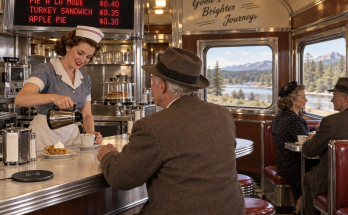
He reaches out, slow, like he’s scared she’ll pull away, brushes the silver streak in her hair with his calloused fingertips, his knuckle grazing her warm cheek. She doesn’t flinch, doesn’t move away, just holds his gaze, her eyes soft and bright. The sun is dipping low over the oak trees now, painting the sky pink and tangerine, the crowd at the cookoff thinning out, most people packing up their booths, hauling coolers and folding chairs to their cars. He nods at his F-250, the one with the Elaina-themed sticker on the back window that says “My co-pilot rides shotgun in my heart”. “There’s a diner down the road that makes pecan pie just like Elaina used to,” he says. “You wanna go? My treat.” She grins, nods, lets him help her up into the high passenger seat, her hand lingering on his shoulder for a beat longer than necessary. He turns the key in the ignition, Willie Nelson’s “Always On My Mind” crackles to life on the old country station, the same one he and Elaina used to listen to on cross country trips. He doesn’t change the station, rests his hand on the gear shift, and for the first time in 8 years, he doesn’t feel guilty for smiling.