Ronan O’Malley, 62, retired wildland fire crew lead, spent 34 years fighting blazes across the Pacific Northwest before he hung up his hard hat eight years prior, two weeks after his wife Elaine lost her three-year fight with ovarian cancer. His stubborn streak was the thing that made him good at his job, the thing that kept his crew safe through dozens of unseasonable summer infernos, but it had turned into a flaw in the years after Elaine died: he’d holed up in his cabin outside Silverton, turning down every blind date his adult daughters pushed his way, convinced any new romantic connection was a betrayal of the 32 years he’d shared with Elaine.
Mid-July, he’d dragged himself to the annual Silverton craft beer festival only because his youngest daughter had begged him to get out of the house for a few hours. The air was thick with the smell of charred bratwurst, citronella candles, and sharp, hoppy microbrew from 20 local tap houses, the bluegrass band on the small stage plucking through a cover of “Foggy Mountain Breakdown” so loud his molars hummed when he stood 10 feet from the speakers. He was leaning against a splintered pine picnic table, peeling the label off his second hazy IPA with scarred, calloused fingers that still bore faint white burn marks from the 2017 Gorge fire, when he twisted to dump a handful of peanut shells into a nearby trash can, his elbow connecting solidly with soft, warm fabric right over someone’s sternum.

He started to apologize, gruff, already bracing for a sharp rebuke, and looked up to see Mara Hale, Elaine’s second cousin, grinning so wide the corners of her eyes crinkled. She was 58, he remembered, ran a beekeeping supply co-op out of Bend, he hadn’t seen her since Elaine’s funeral, when she’d hugged him and slipped a jar of wildflower honey into his coat pocket, told him it’d soothe the ragged cough he’d picked up that fire season. She wore faded canvas overalls over a white linen tank top, a smudge of beeswax on her left jaw, her silver hair pulled back in a braid dotted with tiny clover stems she’d probably picked on the drive over.
She leaned in so her mouth was close to his ear, her shoulder pressed firm to his sun-warmed bicep, and he could smell clover honey, lemon shampoo, and a hint of the same peach hard cider Elaine used to drink on hot porch nights. “Thought that was you,” she yelled over the music, her breath warm against the side of his neck. “Was wondering when I’d run into your grumpy self. You still hiding out up in that cabin like a hermit?”
He snorted, suddenly self-conscious of the three days of gray stubble on his jaw, the rip in the knee of his work jeans. He teased her back, brought up the time she’d showed up to his and Elaine’s wedding with neon pink hair, tried to convince the best man to climb the church steeple to tuck a small beehive in the bell tower as a “good luck charm.” She laughed so hard she snorted, slapping his arm playfully, her palm warm even through the thick flannel of his shirt.
They talked for an hour, standing so close their knees brushed every time one of them shifted their weight. He told her he’d been fixing up the old fishing access trail on his property, planting native wildflowers to draw pollinators, and her eyes lit up, bright as sun through amber honey. She said she’d been looking for a remote spot to place a dozen experimental hives for native bumblebees, no pesticides, no nearby housing to bother anyone with allergies. The thought of her coming up to his cabin, the space he’d kept only for Elaine’s memory for eight years, made his chest tight, a weird mix of sharp, thrumming want he hadn’t felt in decades and hot, twisting guilt that made his throat feel thick.
The voice in the back of his head, the one that had kept him alone all those years, hissed that this was wrong, that Mara had known Elaine, that he was spitting on the memory of the only woman he’d ever loved. But then she tucked a stray strand of hair behind her ear, and her knuckle brushed his cheek, accidental, and he didn’t pull away. She didn’t look at him like he was a widower to pity, like he was broken. She looked at him like he was the same idiot who’d carried her three miles out of the Mount Hood wilderness when she sprained her ankle on a hike 22 years prior, like he was the guy who’d once stayed up three nights with Elaine helping her can 400 jars of jam for the county fair.
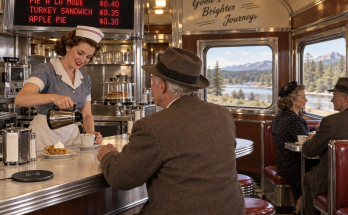
She nodded her head toward the parking lot, the hand holding her half-empty cider brushing his wrist, her skin cool from the condensation on the glass. “The pie at the diner on the edge of town is still the best in the state,” she said, loud enough only he could hear, the music softening into a slow waltz. “You wanna get out of here? We can talk about the hive spot. Or not. Whatever you want.”
He hesitated for two full, thudding heartbeats, then nodded. He grabbed their empty cans, tossed them in the recycling bin, and walked beside her to his beat-up 2008 Ford F-150, his hand brushing hers twice before he worked up the nerve to open the passenger door for her. When he held his hand out to help her climb up, she laced their fingers together for three quiet seconds, her palm calloused from handling pine hive frames, warm, alive.
He climbed into the driver’s seat, turned the key in the ignition, and the old radio cut on to a scratchy recording of Johnny Cash’s “I Walk the Line”, the song he and Elaine had danced to at their wedding. He glanced at the photo of Elaine taped to the dashboard, the one where she was grinning, covered in apricot jam, and for the first time in eight years, he didn’t feel a twist of guilt when he reached over to turn the AC on, his arm brushing Mara’s knee.