Ronan O’Malley, 62, retired high-voltage lineman for the rural Athens County electric co-op, had spent the three years since his wife Eileen’s death holed up in the hand-hewn cabin he’d built on 12 acres of oak woods, only leaving to grab parts for his half-restored 1972 F-150 or drop excess tomato and squash crops off for his 82-year-old next-door neighbor Marnie. His biggest personality flaw was a stubborn refusal to admit he was lonely; he’d brushed off every half-hearted set-up from local friends, insisted dating at his age was juvenile nonsense, that he was perfectly fine eating frozen meatloaf for dinner alone every night. Marnie had threatened to dump a sack of overripe, rotting zucchini on his porch step if he skipped the annual volunteer fire department chili cookoff that Saturday, so he’d showed up in his faded gray flannel, Ford ball cap pulled low over his graying hair, planned to chug one cheap beer and slip out before anyone could corner him.
He propped himself against the cinder block wall by the outdoor cooler, half-watching a group of teen boys bicker over a botched cornhole toss, when she reached for the same root beer he did on the top shelf. Their knuckles brushed first, a thick, work-worn callus on her index finger scraping the back of his calloused hand, and he jerked back like he’d touched a live 12,000 volt line, face heating up so fast he was sure his ears were bright red. She laughed, low and warm, not the patronizing snicker he was used to from townsfolk who wrote him off as a reclusive crank. She was Elara Voss, 58, he’d learn later, owner of the new used bookstore on the town square, who’d moved from Chicago six months prior after a 32-year marriage ended so amicably she and her ex still texted every week to rant about bad 90s action movies. She had silver streaks cutting through her dark curly hair, pulled back in a frayed red bandana, a faint grease stain on the knee of her dark jeans, and she smelled like vanilla candle wax and pine cleaning spray.

He could feel half the crowd craning their necks to stare. Everyone in town had spent the last two years trying to pair him off with every widowed or divorced woman within a 25-mile radius, and he’d turned every single offer down flat, still carrying a sharp, familiar guilt at the thought of even looking at another woman after Eileen’s fatal deer collision on the backroad outside his cabin. He told himself he should mumble an awkward apology, grab his root beer, climb in his truck and go home, hide out with his truck parts and a John Wayne western for the rest of the weekend. But she leaned against the cooler beside him, close enough that her shoulder brushed his when she took a sip of her drink, and said she recognized his hat—she had the exact same 1972 F-150 sitting in her garage, hadn’t been able to get it to turn over for three weeks, every mechanic in town had quoted her a laughably inflated price for work she knew was basic.
He teased her back, said most of the local mechanics couldn’t change a spark plug without charging $120 for “diagnostics”, and she grinned, eyes crinkling at the corners, holding his gaze for three full beats longer than casual conversation called for. He could hear the roar of the crowd behind them, the crackle of the bonfire at the center of the field, someone yelling about winning the $500 chili grand prize, but all he could focus on was the way her thumb traced the rim of her root beer can, the faint smudge of blue ink on her wrist from stamping used book spines that morning. The guilt nagged at him, sharp as a splinter, told him he was being disrespectful to Eileen’s memory, that he was too old for this silly, fluttery excitement that felt like he was 16 again, asking a girl to prom. But the longer he talked to her, the quieter that voice got. She didn’t ask about Eileen, didn’t pity him for being alone, didn’t mention the gossip he knew was already circulating through the crowd. She ranted about the library book bans that had pushed her to leave Chicago, complained about the family of raccoons that kept breaking into her bookstore’s back porch to steal her sunflower seed, told him she’d never driven a manual transmission before but was determined to learn.
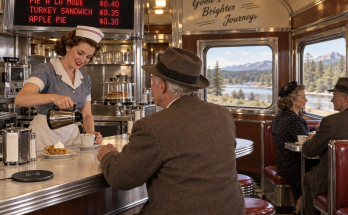
When a group of local church ladies started walking toward them, faces lit up with the clear intent to meddle, he nodded toward the dark parking lot behind the cooler. “I got a warm apple pie waiting for me at the diner up Route 33. And I got all the spark plug parts you need for that F-150 in my truck bed. Wanna ditch this?” She didn’t even hesitate, grabbed her worn denim jacket off the cooler handle, followed him through the back exit, ducking behind a stack of folding chairs to avoid the gossips.
They climbed into his beat-up truck, he rolled the windows all the way down, crisp October air blowing in, carrying the smell of cut hay and distant wood smoke. Johnny Cash’s “Folsom Prison Blues” hummed low on the crackling radio. Halfway to the diner, she reached over, rested her hand lightly on his forearm, that same rough callus pressing soft against his skin. He didn’t pull away.