Manny Ruiz, 62, retired air traffic controller from Pittsburgh’s eastern suburbs, still carried the hunch of someone who spent 37 years staring at glowing radar screens 12 hours a shift, his left shoulder perpetually a quarter inch higher than his right from leaning into his headset. He’d avoided the local VFW’s Friday fish fry for seven years after his wife Lena passed, only started showing up three months prior when his physical therapist nagged him into leaving the house more than twice a week. The screen door whined when he pushed through, the smell of fried cod, apple cider vinegar, and stale Pabst hitting him square in the chest before he even crossed the threshold. He grabbed his usual chipped Formica stool at the far end of the bar, nodded at the bartender, and glanced toward the food line, surprised to see a woman he didn’t recognize wiping down the steam table instead of the usual gruff 78-year-old vet who burned hush puppies half the time.
She was in a faded VFW hoodie, black jeans scuffed at the knees, her dark hair pulled back in a messy braid streaked with silver at the temples. When she caught him looking, she waved, her smile crinkling the corners of hazel eyes flecked with green, and he froze. He knew her. Clara Bennett, Jake Bennett’s widow. Jake had been 19 when he shadowed Manny for three months in the tower before enlisting in the Air Force, a kid with a lopsided grin and a death wish to fly fighter jets, killed in a training crash two years prior. Manny had gone to the funeral, stood in the back of the church so he didn’t have to talk to her, left a card with a check for her mortgage and slipped out before the service ended. He’d thought even looking at her too long felt like a betrayal, of Jake, of Lena, of the quiet, lonely routine he’d built that left no room for anything soft or messy.

He ordered the fish platter extra crispy with coleslaw, kept his eyes fixed on the football game playing on the beat-up CRT above the bar until he heard her voice next to his ear, warm and a little rough like she smoked a pack a day. “Heard you like extra tartar sauce,” she said, and when he turned, she held out a ramekin stacked so high the stuff dripped over the edge. Their fingers brushed when he took it, and he felt the rough callus on the side of her wrist, the kind you get from digging in a garden for hours, and she smelled like lemon dish soap and fried cornmeal, nothing like the perfume Lena used to wear, nothing he’d spent seven years avoiding. He mumbled a thanks, made a dumb joke about the old cook never giving him more than a thimble full of tartar, and she laughed, loud and unselfconscious, leaning against the bar so her shoulder brushed his bicep for half a second before she pushed off to help an older vet with his order.
He ate slow, picking at the coleslaw, his eyes drifting back to her every few minutes even when he told himself to stop. He felt stupid, a 62-year-old man who’d handled mid-air emergencies without breaking a sweat, flustered over a woman who’d handed him tartar sauce. A mean little voice in the back of his head kept saying it was wrong, that he was too old, that Jake would roll in his grave, that he was disrespecting Lena’s memory by even thinking about talking to her for longer than 10 seconds. By the time most of the crowd cleared out, the football game long over, he’d ordered three beers, more than he’d drunk in a single night in five years, and was reaching for his wallet to leave when she slid onto the stool next to him, close enough he could feel heat radiating off her leg through his jeans.
“I recognized you the second you walked in three months ago,” she said, picking at a loose thread on her hoodie, not looking at him at first. “Jake talked about you all the time. Said you were the only person who didn’t tell him he was too dumb to be a pilot.” She looked up then, eyes soft, and tapped the faded air traffic control patch sewn to his flannel breast, her fingers lingering for a beat. “I was gonna say hi earlier, but you always looked like you wanted to be left alone. Figured I’d wait til you stopped scowling so much.” Manny laughed, surprised, and admitted he’d avoided talking to her because he felt like he was crossing a line, like he had no right to be even sitting next to her after what happened to Jake. She snort-laughed, shook her head, and put her hand on top of his where it rested on the bar. Her palm was warm, calloused, and he didn’t pull away. “Jake would’ve teased you so hard for being such a stick in the mud,” she said. “He kept asking if you’d finally started dating again after Lena died. Said you deserved to stop being lonely.”
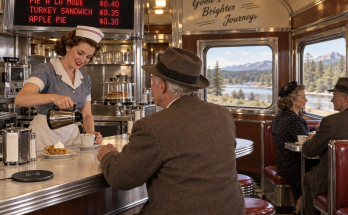
They talked for an hour after that, the bartender wiping down glasses in the back, ignoring them like he’d seen a hundred similar conversations play out over the decades. She told him she’d taken the part-time cook job to get out of the house, grew tomatoes and peppers in her backyard and canned them every fall, hated country but loved old blues. He told her about Lena, the lake trips they took every summer, how he still burned toast every morning because he’d never learned to use the toaster she’d bought him two weeks before she died. When he left, she scribbled her phone number on a VFW logo napkin, folded it up, and pressed it into his palm, her thumb brushing the scar on his knuckle he’d gotten fixing his truck at 22. “Diner on Main at 9 tomorrow,” she said. “They have apple pie that’ll make you forget every bad thing that ever happened to you.”
He walked out to his beat-up 2008 Ford F150, the air crisp with the smell of burning leaves, the napkin crumpled tight in his jacket pocket. He turned the key, the old truck sputtering to life, and the first thing that came on the radio was a blues song he’d heard Lena play a hundred times. He shifted into drive, pulled out of the parking lot, and made a mental note to stop at the corner bakery before the diner to pick up a jar of the strawberry jam Lena used to love, just in case she wanted something extra with her pie.