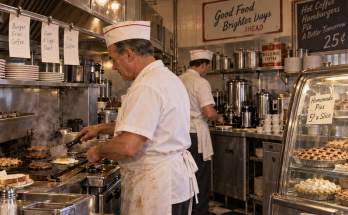
Ronan O’Malley, 62, spent 38 years hauling salmon out of the Columbia River’s choppy gray waters before he sold his boat last spring, calloused palms still rough enough to snag cotton if he’s not careful. He’s manning the grilled salmon booth at Astoria’s annual end-of-season block party, sweat rolling down the side of his neck under a faded Columbia fishing hat, a half-drunk Pabst tucked under the folding table out of the city council’s sight. Every time he glances across the street, the group of retired longshoremen camped at the picnic table behind him hoot loud enough to turn heads, so he keeps his eyes glued to the fillets sizzling over alder wood, ignoring the warm prickle up the back of his neck. He’s refused to so much as get coffee with anyone since his wife left him for a Bend real estate agent 12 years back, convinced he’s too gruff, too set in his 5 a.m. wakeup and beer-for-dinner routines to not ruin whatever someone tries to build with him. The whole town’s been placing bets on when he’ll work up the nerve to talk to Clara, his new next-door neighbor who moved from Portland three months prior to open a used mystery bookstore downtown, and he hates every second of the attention.
She crosses the street right as he flips a fillet crisped perfectly on the edges, cutoffs slung low on her hips, a faded Agatha Christie tee clinging to her shoulders, a half-empty cup of lavender lemonade in one hand. He fumbles the tongs, drops the fillet straight onto the hot grill, and smoke curls up stinging his eyes before he can grab it. She laughs, low and warm, no bite to it, when she reaches the table, and he swears his ears go bright red under the hat. “One salmon plate, please,” she says, leaning in a little so he can hear her over the mariachi band playing two booths over, her shoulder brushing the scarred skin of his bicep for half a second. He can smell coconut shampoo and the faint tang of recent rain on her canvas jacket, and for a second he forgets how to speak. He fumbles a paper plate, piles the fillet on it with coleslaw and a wedge of lemon, and when he hands it over, she nods at the beat-up 1972 Penn Spinfisher reel he’s got sitting on the edge of the table, the one he was bringing to the youth fishing workshop later that day. “My dad had that exact same reel,” she says. “Took me steelhead fishing every spring until he passed. I’ve been looking for one for months, couldn’t find one that wasn’t beat to hell.”

He finds himself leaning in too, ignoring the longshoremen hooting so loud one of them snorts beer out his nose. He explains he fixed that one up himself, replaced the drag system last winter, has three more in his garage he’s been restoring for the teen fishing program. She asks genuine questions, not the polite small talk people usually make with him when they find out he used to run a fishing boat, and he finds himself telling her about the time he caught a 72-pound king on that exact reel back in 2018, fought it for two hours before he could haul it over the rail. She’s listening so intently she’s forgotten to take a bite of her salmon, her elbow resting on the edge of the table, eyes locked on his, and the noise of the party fades to a low hum in the background for a second. The rational part of his brain is screaming that half the town is watching, that by tomorrow every house within a five-block radius will be talking about how Ronan O’Malley finally stopped moping and talked to the bookstore lady, and he hates the idea of people picking apart his private business like it’s cheap gossip. But the other part of him, the part he’s buried for 12 years, is warm, light, like he’s 19 again and talking to a pretty girl at a dock party for the first time.
A seven-year-old he recognizes from the youth program comes tearing between them, chasing a golden retriever, and slams into her side hard enough that the lemonade slips out of her hand, splattering bright purple across both of their shirts. She yelps, and he grabs a handful of napkins off the stack on the table, dabbing at the stain on her tee first before he thinks, his knuckle brushing the soft curve of her breast for half a second. Both of them freeze, eye contact locking, and he doesn’t apologize, doesn’t stammer out an excuse, just holds her gaze, his throat tight. “Got a stain stick at my place,” he says, his voice rougher than he means it to be. “Two blocks up. We can get out of this chaos for a minute, if you want.” He expects her to say no, expects her to laugh it off and head back to her book table, but she nods, wiping a drop of lemonade off her cheek with the back of her hand. “That sounds perfect,” she says.
They walk away from the party without saying goodbye to anyone, the sound of the mariachi band fading behind them as they turn up his street, the air cool now that the sun’s dipping below the Astoria Bridge, crickets starting to chirp in the grass along the sidewalk. She slips her hand into the crook of his elbow when they cross the street, and he doesn’t pull away. He unlocks his front door, lets her step inside first, and she pauses in the entryway, running her finger along the mounted 72-pound king he has hanging over the couch, the one he told her about earlier. “You have to tell me the rest of that story,” she says, grinning over her shoulder at him, and he swears his chest feels lighter than it has in over a decade. He grabs the stain stick from the laundry room, hands it to her, and when she takes it, her fingers curl around his for a beat longer than necessary, warm and soft against his calloused skin. He leans against the kitchen counter, pulls two cold IPAs from the fridge, and doesn’t bother checking if the neighbors can see them through the front window.