Elias Thorne, 63, makes his living restoring antique typewriters from the sunroom of his creaky 1920s cottage in western Michigan. His biggest flaw, one his late wife teased him about constantly until she died of breast cancer eight years prior, is that he would rather saw off his own left foot than ask another person for help with anything, no matter how small. He’s manning a booth at the annual small-town summer street fair on a sweltering July afternoon, selling a handful of fully restored entry-level machines to raise money for the local library’s after-school writing program, when his bad knee—leftover from a 1982 college hockey injury that never healed right—starts throbbing so bad he has to lean against the edge of the folding table to stay upright.
He’d packed a folding camp chair that morning, but when he yanks it out from under the table, the metal leg is bent, stuck halfway open. He jiggles it, grunts, shoves at the joint hard enough his knuckles scrape raw, too proud to flag down the lanky 16-year-old volunteer wandering the fairgrounds handing out free bottles of water. He’s still fighting with the chair when a shadow falls over him, and he looks up to see Marnie, the glassblower who moved into the cottage two doors down three months prior, holding a sweating paper cup of pink lemonade, her cutoffs caked in sawdust, a streak of cobalt blue glass stain across her left forearm. He’s only ever waved at her from a distance before, too wrapped up in his own routine to stop and introduce himself.

She smirks, nods at the chair. “That thing’s been broken since last year’s fair. The committee buys them cheap from a dollar store out of Grand Rapids.” Before he can say he’s got it handled, she leans in, sets her lemonade down on the table next to a 1956 Royal Quiet De Luxe, and her bare arm brushes his, warm, calloused at the wrist from working with molten glass. She smells like jasmine perfume and burnt sugar, the same scent that drifts over his fence at dusk when she’s firing pieces in her backyard kiln. She yanks at the bent leg once, adjusts the hinge with her thumbnail, and the chair pops open with a sharp clack.
He mumbles a thank you, sits down fast, half embarrassed, half weirdly flustered, the spot where her arm touched his still tingling. He expects her to leave, but she leans against the edge of the booth, crosses her ankles, and starts asking questions about the typewriters, running a finger gently over the polished black casing of the Royal. She says she writes terrible, unrhymed poetry when she’s waiting for glass to cool, has been using a beat-up 90s laptop that crashes every time she’s three lines in. He finds himself talking more than he has to anyone in months, explaining how he fixes the stuck keys, re-plates the rusted lettering, tunes the carriage so it glides smooth. Every time a group of fairgoers squeezes past the narrow booth, their knees brush, and he doesn’t pull away, even when a jolt of something sharp and warm zips up his spine every time they make contact. She holds eye contact longer than is strictly casual, crinkles her nose when he tells a dumb joke about typewriter repair technicians being the original keyboard warriors, and he has to look away, suddenly guilty, like he’s cheating on the wife he buried eight years ago.
He’s half ready to make an excuse to send her away when the sky opens up out of nowhere, a sharp clap of thunder booming so loud the typewriters rattle on the table, and cold summer rain starts pouring down so hard it stings exposed skin. Everyone on the street scrambles to pack up their booths, and Elias jumps up too fast, his bad knee buckling under him. He stumbles forward, and she catches him, her hands wrapped firm around his biceps, holding him steady, their faces inches apart, rain soaking through both their t-shirts, plastering her blonde hair to her neck. “You’re the most stubborn man I’ve ever met,” she says, quiet enough only he can hear over the sound of the rain. “I know you think moping alone in that cottage is honoring her. But if she loved you half as much as the photos on your fridge say she did, she’d probably climb out of that grave to kick your ass for wasting all this time.”
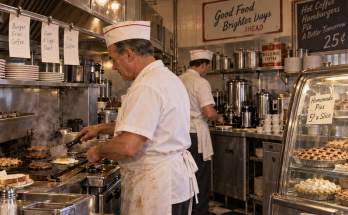
The words hit him like a punch to the chest, and for a second he can’t breathe, because no one’s said that out loud before, not even his sister, not even his best friend who’s been trying to set him up on blind dates for years. He doesn’t pull away. They work fast after that, wrapping the typewriters in plastic tarps, shoving the folding table and chair into the back of his pickup, their sides pressed tight together under the flimsy beach umbrella he stashed under the booth that morning. When everything’s packed, he doesn’t even think about it before he asks if she wants to get dinner at the diner down the street, the one with the neon burger sign that’s been there since the 70s, to say thank you. She grins, says yes, and steals a sip of his lukewarm coffee while he locks the truck tailgate.
They sit in a vinyl booth at the back of the diner, the rain still tapping against the window, and he orders meatloaf with mashed potatoes, she orders a cheeseburger with extra pickles. She steals a bite of his potatoes halfway through the meal, and he doesn’t even pretend to be annoyed. He wipes a smudge of gravy off her chin with the pad of his thumb, and for the first time in eight years, he doesn’t feel guilty for smiling.