The first thing you need to understand about Diana is that she never did anything by accident. Not the way she crossed her legs at the bar, not the way her fingers lingered on the glass, not the way she ordered that double whiskey neat when every other woman in the place was drinking white wine.
She was watching him watch her. That was the game.
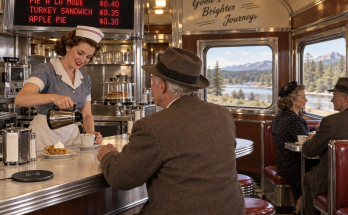
It was a Tuesday, which meant the hotel bar was nearly empty. Just businessmen with loosened ties and that particular loneliness that comes from too many airport lounges and not enough skin. Diana was sixty-four, divorced eleven years, and she’d learned something most women her age either forgot or never knew: the power of being absolutely, devastatingly deliberate.
The whiskey arrived, amber and dangerous. She lifted it to her lips without ice, without mixer, without any of the softening agents women were supposed to prefer. The burn was immediate, spreading down her throat like a lover’s hand. She let her eyes close for just a moment—long enough for him to notice, not long enough to seem dramatic.
When she opened them, he was there.
“That’s a serious drink,” he said. Not a line, exactly. More of an observation, delivered with a voice that sounded like it had spent decades in boardrooms and bedrooms alike.
“I’m a serious woman,” Diana replied. She didn’t turn to face him fully. That would be too eager. Instead, she angled her body just enough—shoulders open, posture deliberate, the neckline of her dress doing exactly what she’d designed it to do.
He was younger. Not by much, maybe fifteen years. But enough that his colleagues would have called her a “cougar” behind his back, as if that word meant anything other than small minds trying to categorize what they didn’t understand.
“May I?” He gestured to the stool beside her.
She let the silence stretch. Three seconds. Four. Long enough for him to question himself, to feel the rejection before it came. Then: “You may.”
His name was Richard. He was in town for a conference, staying in this very hotel, already bored with the scheduled networking events. As he spoke, Diana watched his mouth. Not his eyes—his mouth. She’d learned that trick years ago. Most people couldn’t maintain eye contact when you stared at their lips. It made them nervous, made them stumble, made them want to prove themselves.
She wanted him to prove himself.
“What brings you here?” he asked.
“The whiskey,” she said. Then, after a beat: “And the view.”
She wasn’t looking at the window.
Richard swallowed. She watched his Adam’s apple move and felt a familiar heat low in her belly. It had been months since she’d done this—since she’d allowed herself to want something purely, selfishly, without considering whether it was appropriate or dignified or any of the other words people used to keep women her age in their place.
“I should tell you,” he said, leaning closer, “I’m not very good at reading signals.”
“Then I’ll be clear.” Diana set down her glass with a deliberate clink. “I’m going to finish this drink. Then I’m going to my room on the eighth floor. If you’re interested in continuing this conversation in a place where I don’t have to wear shoes, you’ll find the elevator.”
She didn’t wait for his response. She finished her whiskey in one smooth motion—no wince, no gasp, just the steady burn she’d learned to love—and stood. Her dress was silk, midnight blue, cut in a way that suggested rather than revealed. As she walked toward the elevator, she didn’t look back. She didn’t need to.
She heard him follow.
The elevator doors closed behind them with a soft chime, and suddenly they were alone in that small, mirrored space. Diana pressed the button for eight and then—because she’d never been one for patience—she turned and kissed him.
It wasn’t gentle. It wasn’t tentative. It was the kiss of a woman who knew exactly what she wanted and had grown tired of pretending otherwise. Her fingers found his collar, pulled him closer, and she tasted whiskey and surprise and something else—hunger, maybe, or the relief of being wanted by someone who knew how to take control.
“God,” he breathed against her mouth when they finally separated. “Who are you?”
“Someone who stopped apologizing for wanting things,” she said.
The elevator opened. She led him down the hall to her room, already fishing the keycard from her purse. Her hands were steady. Her heart was not.
Inside, she didn’t bother with lights. The city glow through the windows was enough—enough to see the outline of him, the way his hands hovered uncertainly at his sides, waiting for permission. She found that charming. Most men her age had forgotten how to wait.
“Take off your jacket,” she said. Not a request.
He obeyed. Then his tie. Then, at her raised eyebrow, his shirt. She watched the fabric fall away and felt her breath catch. He was lean, muscled in that way that suggested tennis or swimming rather than gym obsession. A scar traced his left shoulder. She wanted to know the story, but later. Stories were for after.
“Your turn,” he said, and there was something in his voice—not entitlement, but hope. Hope that she would let him see her, all of her, without the armor of sophistication she’d worn downstairs.
She turned her back. “Unzip me.”
His fingers found the tab at the base of her neck and drew it down slowly, slowly, the sound loud in the quiet room. The dress loosened, pooled at her feet, and she stepped out of it wearing nothing but black lace and intention.
Richard made a sound—part prayer, part curse—and then his hands were on her waist, turning her, pulling her against him. She felt his heart hammering through his chest and smiled against his neck. This was what she’d come for. This collision of need and nerve, this reminder that her body was still capable of making someone desperate.
They didn’t make it to the bed at first. The wall was closer, and Diana had always preferred efficiency. He lifted her easily—she was small, compact, strong from years of yoga and stubbornness—and she wrapped her legs around his waist, feeling the hard press of him through his trousers. His mouth found her throat, her collarbone, the hollow above her breast where her pulse beat visibly against her skin.
“Tell me what you want,” he gasped.
“Everything,” she said. “I want everything, and I want it now.”
Later—much later—they lay tangled in sheets that smelled like expensive perfume and sweat and the particular musk of satisfied desire. Richard traced patterns on her bare shoulder while she stared at the ceiling and felt, for the first time in months, completely present in her own skin.
“Why whiskey?” he asked eventually. “Really?”
Diana turned her head to look at him. In the dark, he looked younger, softer. Vulnerable in a way that made her want to protect him and devour him at the same time.
“Because wine is for women who are still trying to be liked,” she said. “Whiskey is for women who already know they’re wanted.”
He was silent for a moment. Then: “Will I see you again?”
“That depends.” She propped herself up on one elbow, enjoying the way his eyes traveled down her body, unapologetic now, greedy in a way that made her feel powerful. “Are you free tomorrow night?”
“I’m free every night.”
“Then yes.” She lay back down, pulling the sheet up to her waist but no higher. “You’ll see me again.”
Richard smiled, and it transformed his face from handsome to beautiful. Diana felt something shift in her chest—not love, exactly. Something more honest than that. Recognition. The acknowledgment of two people who had found each other in the dark and decided to stay there a while.
Outside, the city hummed with its million private stories. Inside, Diana closed her eyes and let herself be held, let herself want, let herself be the woman who ordered whiskey and got exactly what she was asking for.
The glass downstairs sat empty on the bar. The bartender would clear it eventually, never knowing what it had started. That was the thing about signals—if you knew how to send them, if you were brave enough to be clear, the whole world became an invitation.
Diana had stopped waiting for invitations years ago.
She sent them instead.