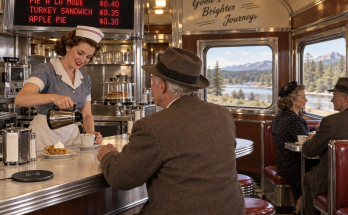
Javi Mendez, 52, makes his living sanding dents out of 1960s Airstreams and reupholstering their cracked vinyl booths out of a cinder block workshop on the east edge of Austin. He’s got a scar slashing across his left eyebrow from a falling trailer hitch three years back, grease permanently crusted under the edges of his fingernails, and a rule he’s stuck to for eight years, ever since his ex-wife left him for a software sales guy she met at a state park: no flirting, no casual dates, no letting anyone get close enough to mess with the quiet routine he’s built. He only leaves his shop after dark for beer runs, the occasional church food drive, and the monthly east side food truck rally, where he can grab a brisket taco and avoid small talk by hovering near the port-a-potties until he’s ready to leave.
He’s halfway through a Shiner Bock at the October rally, leaning against the wheel well of the 1962 Airstream he just finished restoring for a tamale vendor, when he spots Clara Bennett. She’s the pastor’s wife from the small non-denominational church down the street, the one he’s helped fix folding tables and patch the roof of the youth group shed for the last four years. She’s standing behind a folding table stacked with glass pie dishes, wearing a faded denim jacket and a white apron dotted with peach juice, selling slices for the youth group’s mission trip to Costa Rica. He freezes. He’s been avoiding her for three weeks, ever since she stopped by his shop to ask him to fix the church’s old coffee pot, and he caught himself staring at the freckles splashed across her forearms as she leaned against his workbench, her knee brushing his for half a second. He’d stammered through the interaction, charged her zero for the repair, and practically sprinted back into his shop when she left, ashamed at the way his heart had hammered in his chest like he was 16 again.

He turns to leave, but she spots him before he can slip into the crowd, waves so hard her apron strings flutter. He can’t be rude, not when she’s baked 18 pies for the kids, so he trudges over, boots crunching on discarded napkins and crushed peanut shells. Halfway there, a 10-year-old on a neon pink scooter slams into his side, and he stumbles forward, reaching out to catch himself. His calloused palm wraps around her soft forearm, the skin warm and smooth under his fingers, and she gasps, quiet, not pulling away. They hold eye contact for three full beats, longer than two people who are just acquaintances ever should, before he yanks his hand back, mumbles an apology, brushes crumbs off his flannel shirt.
“Relax, I’m not made of glass,” she says, grinning, and pulls a paper plate out from under the table, plops a thick slice of peach pie on it, hands it to him for free. He sits down on the weathered picnic bench next to her booth, and they talk while the crowd thins out, the sun dipping below the oak trees, painting the sky pale pink and orange. She tells him her husband’s been gone for three months on a relief trip to Haiti, that she’s been sleeping with the porch light on because the parsonage creaks so bad at night, that she watches him work in his shop sometimes through the gap in the oak trees behind her house, admiring how focused he gets when he’s welding. He tells her about the Airstream he’s restoring for his daughter’s graduation gift, about how he hasn’t baked a pie of his own since his ex left, about how he hates going to church potlucks because everyone keeps trying to set him up with their divorced aunts.
The first raindrop hits his neck ten minutes later, cold and sharp, and then the sky opens up, people scrambling to pack up their booths, food truck workers slamming shut their serving windows. He helps her fold up the tablecloth, stack the pie dishes in a blue plastic cooler, and when they both reach for the cooler handle at the same time, their hands brush. He doesn’t move his. She doesn’t move hers. They stand there for a second, rain dotting their shirts, the smell of wet asphalt and cinnamon from the pie filling wrapping around them, her shoulder pressed to his, her knee brushing his jeans. “I don’t want to go home to an empty house,” she says, quiet enough only he can hear, her breath warm against his ear.
He doesn’t hesitate, not even for a second, even though he knows every single person in this neighborhood knows who she is, even though he’s spent eight years telling himself he doesn’t need anyone. “I got a space heater in my workshop,” he says, picking up the cooler with one hand, the other brushing the small of her back to guide her through the rain. “Baked a pecan pie last night, still half left. Burnt the crust a little, but it’s edible.”
She laughs, tucks her arm into his, and he can feel the warmth of her through his wet flannel, the soft press of her hip against his as they walk down the dark sidewalk, rain pouring down around them, no one else out on the street. He fumbles for his workshop keys in his jeans pocket, and when his fingers close around the cold metal, he doesn’t feel guilty for even a second.