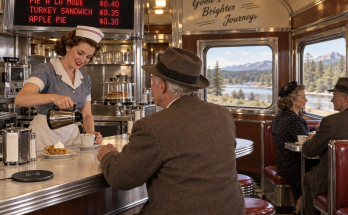
Elias Voss, 53, leans against the scuffed oak bar at The Driftwood, napkin tucked into the collar of his faded Carhartt shirt, picking bits of fried catfish skin off his plate. He retired from smokejumping four years prior, now builds custom fly rods for a living out of his converted garage workshop 12 miles outside of town, and he’d only shown up tonight because the bar’s new cook uses the same cornmeal breading his mom used back when he was a kid growing up in eastern Oregon. The place is half full of the usual faces: cattle ranchers in cowboy hats, fly fishing guides still wearing their wader boots, a handful of tourists who got lost on their way to Yellowstone. He’s halfway through his second Pabst Blue Ribbon when he catches the scent of pine soap and cherry lip balm, and someone slides onto the stool two spots down from him.
He glances over. It’s Mara Ruiz, the new U.S. Forest Service ranger who moved to town two weeks prior, the woman he’d been actively avoiding for 10 days straight because he’d heard through the local gossip mill she was pushing to shut down all backcountry access to the high alpine lakes he uses to test his rods. She’s wearing a forest service uniform shirt with the sleeves rolled up to her elbows, a silver ring shaped like a trout on her index finger, and she’s got a smudge of dirt on her left cheek that makes her look like she just spent the day hiking trail lines instead of sitting in an office. She flags the bartender down, orders a bourbon on the rocks, and when she reaches across the bar for the stack of paper napkins, her knuckles brush his. He flinches like he got burned, and she smirks, holding eye contact for three full seconds before she pulls her hand back to grab her drink.

“Elias, right?” she says, and he’s surprised she knows his name. “I saw your rods at the outdoor shop on Main Street last week. The one with the walnut handle and the trout inlay? That’s the nicest custom build I’ve seen in 15 years of fishing these mountains.”
He blinks, taken off guard. He’d been fully prepared to argue with her about the access restrictions, to list off every reason the high lakes are low risk for wildfire, to tell her she’s ruining everyone’s summer for no good reason. Instead, he grunts, nods, takes a sip of his beer. “Rumors said you were gonna shut all those lakes down,” he says, before he can think better of it.
She laughs, a low, rough sound that fits the bar like an old boot. “Rumors are garbage. The restrictions are only for the lower elevation grasslands, the stuff that’s tinder dry after three months of no rain. The high lakes are fine. I was actually up fishing the one at the top of Bear Creek last weekend. Caught a 17 inch cutthroat, released him. He would’ve looked perfect on the end of one of your rods.”
He finds himself smiling, a small, rare thing he only usually does when he’s out on the water alone. They move to a booth in the back of the bar, away from the prying eyes of the regulars who’ve been staring since she sat down next to him, and for the next two hours they talk about fire seasons, about fishing spots no one else in town knows about, about the time he got stuck in a tree for three hours after a jump went wrong, about the time she got chased by a moose while doing trail maintenance in Idaho. Her knee brushes his under the table halfway through her story, and she doesn’t move it. The fabric of her work pants is thin, and he can feel the heat of her leg through his worn denim jeans.
He tells her about the scar on his left forearm, the one he got in the 2018 Oregon wildfire that killed his crew mate, the one that still aches when the humidity drops low enough to make the pine needles crisp underfoot. She reaches across the table without asking, runs her fingers lightly over the raised, pale skin, and he doesn’t pull away. For the first time in seven years, he doesn’t feel the urge to shut down, to make an excuse and leave, to hide away in his workshop alone with his half-finished rods and country records playing too loud. The war he’d been waging all night between petty, pre-emptive anger and the slow, warm pull of desire tilts hard toward the latter, and when the bartender yells that last call is in 10 minutes, he asks her if she wants to come back to his shop to look at the rod blanks he has in stock, see if any of them fit what she’s looking for.
She grins, finishes the last of her bourbon, says yes. The air outside is cool, smells like pine and cut alfalfa, crickets chirping loud enough to drown out the sound of the bar’s neon sign humming behind them. He unlocks the door to his workshop, flicks on the string lights strung across the ceiling, and she steps inside first, turning to face him, holding up the half-empty bottle of bourbon she swiped from the bar on their way out.